2BC 第3章
三角関数
三角関数の全体像
高校数学の全体像のように,「○○関数」と名の付く分野では,
\[\boldsymbol{①\class{mathkuu}{\underline{グラフ}}②\class{mathkuu}{\underline{ 方程式・不等式}}③\class{mathkuu}{\underline{最大・最小}}が3大テーマ!}\]
この「3つの目次」を意識しながらマスターしていこう!
特に三角関数においては、次の意識が何よりも重要になる。
特に三角関数においては、次の意識が何よりも重要になる。
Point 2BC 3.1.1 三角関数の式処理の定石
三角関数ときたら・・・
→ 角と種類を統一せよ!
Point 2BC 3.1.2 三角関数の基本公式
三角関数の式処理は,ほぼすべてこの2つ「相互関係」と「加法定理」から始まる。
※2倍角・半角・3倍角・合成の公式は,すべてこの加法定理から導かれる(詳しくは後述)。
① \(\tan\theta=\dfrac{\sin\theta}{\cos\theta}\),
② \(\sin^2\theta+\cos^2\theta=1\),
③ \(1+\tan^2\theta=\dfrac{1}{\cos^2\theta}\)
① \(\sin(\alpha\pm\beta)=\sin\alpha\cos\beta\pm\cos\alpha\sin\beta\)
② \(\cos(\alpha\pm\beta)=\cos\alpha\cos\beta\mp\sin\alpha\sin\beta\)
③ \(\tan(\alpha\pm\beta)=\dfrac{\tan\alpha\pm\tan\beta}{1\mp\tan\alpha\tan\beta}\)
② \(\cos(\alpha\pm\beta)=\cos\alpha\cos\beta\mp\sin\alpha\sin\beta\)
③ \(\tan(\alpha\pm\beta)=\dfrac{\tan\alpha\pm\tan\beta}{1\mp\tan\alpha\tan\beta}\)
※2倍角・半角・3倍角・合成の公式は,すべてこの加法定理から導かれる(詳しくは後述)。
主な基本事項
Point 2BC 3.2.1 正弦・余弦・正接の定義
【直角三角形】において,(左下の図)
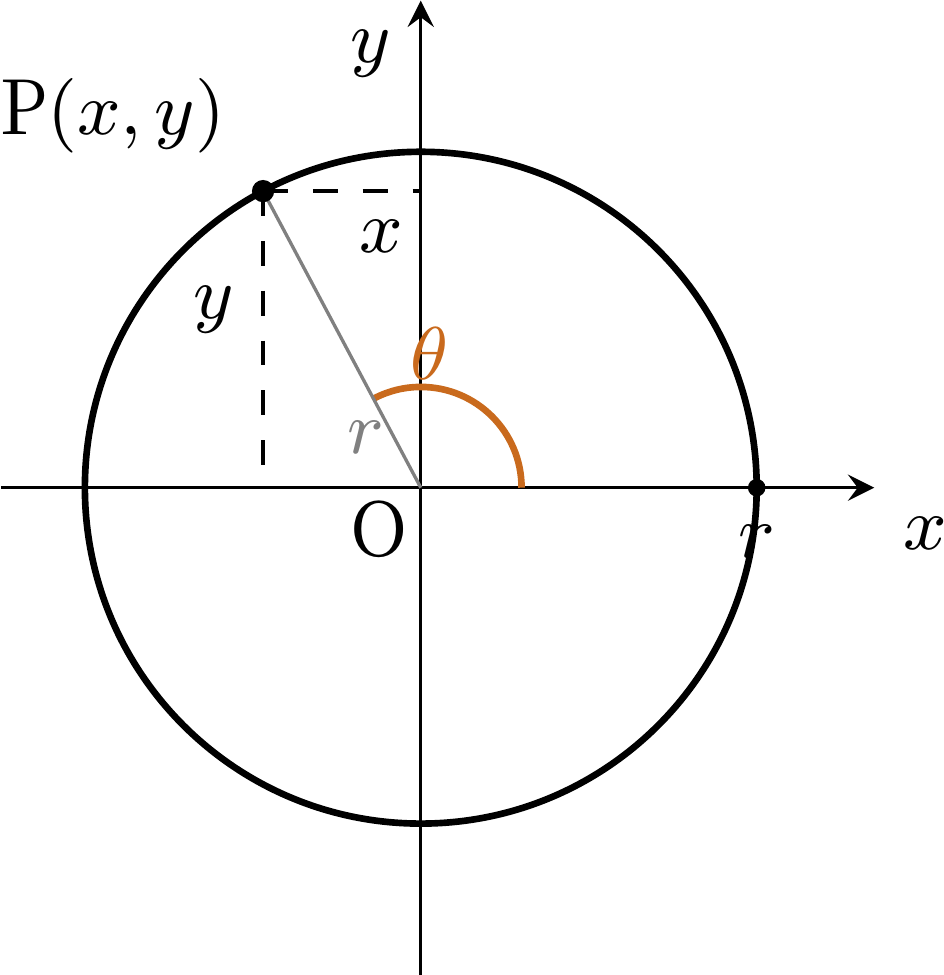
【一般角】の場合、
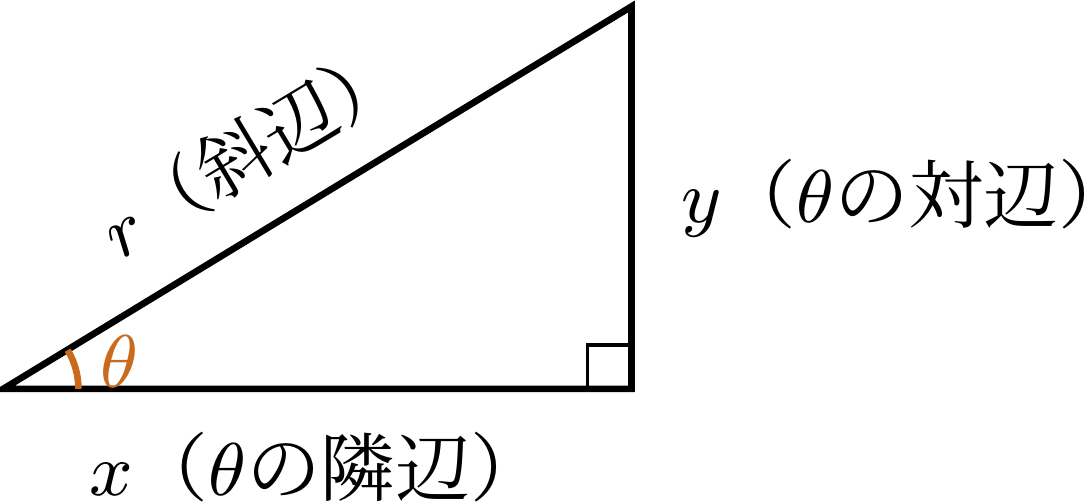
\(\sin\theta =\class{mathkuu}{\underline{\dfrac{y}{r}}}=\dfrac{対辺}{斜辺}\), \(\cos\theta =\class{mathkuu}{\underline{\dfrac{x}{r}}}=\dfrac{隣辺}{斜辺}\), \(\tan\theta =\class{mathkuu}{\underline{\dfrac{y}{x}}}=\dfrac{対辺}{隣辺}\)
【一般角】の場合、
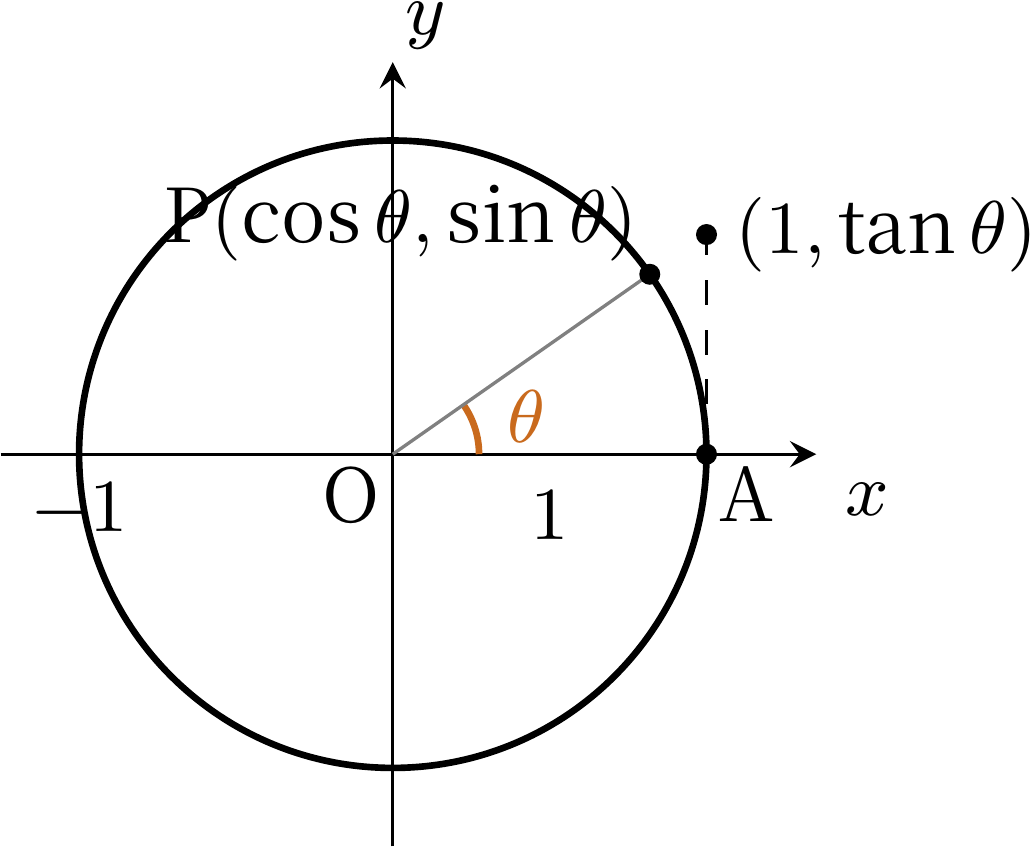
- 単位円上において,(真ん中の図)
\(\sin\) :点Pの\(\class{mathkuu}{\underline{y}}\)座標, \(\cos\) :点Pの\(\class{mathkuu}{\underline{x}}\)座標,
\(\tan \):動径OPの傾きor直線\(\class{mathkuu}{\underline{x=1}}\)と動径OPの交点の\(\class{mathkuu}{\underline{y}}\)座標 - 半径\(r\)の円上の点P(\(x\),\(y\))とするとき,(右下の図)
\(\sin \theta=\class{mathkuu}{\underline{\dfrac{y}{r}}}, \cos \theta=\class{mathkuu}{\underline{\dfrac{x}{r}}}, \tan \theta=\class{mathkuu}{\underline{\dfrac{y}{x}}}\)
Point 2BC 3.2.2 弧度法の定義・度数⇔ラジアンの変換
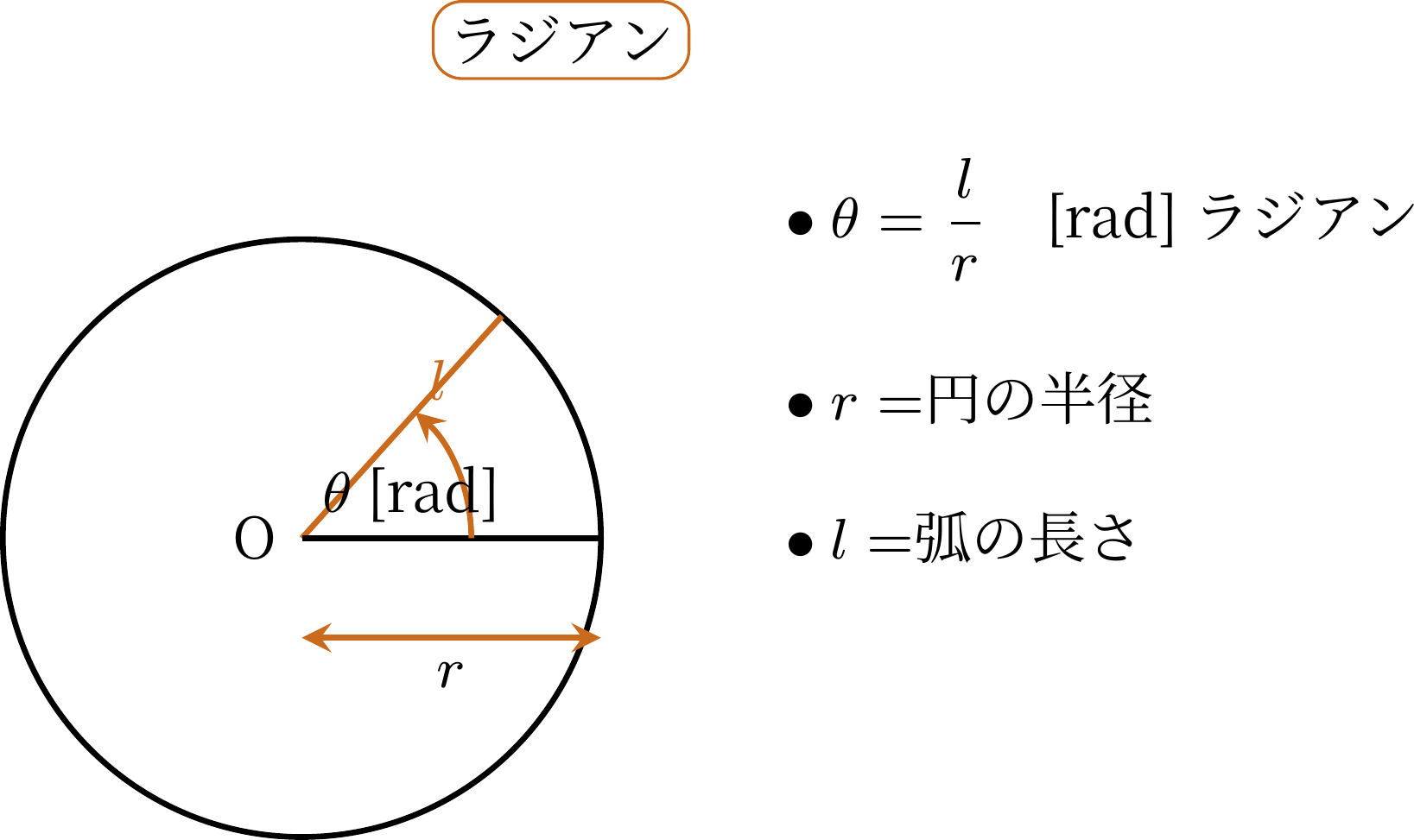
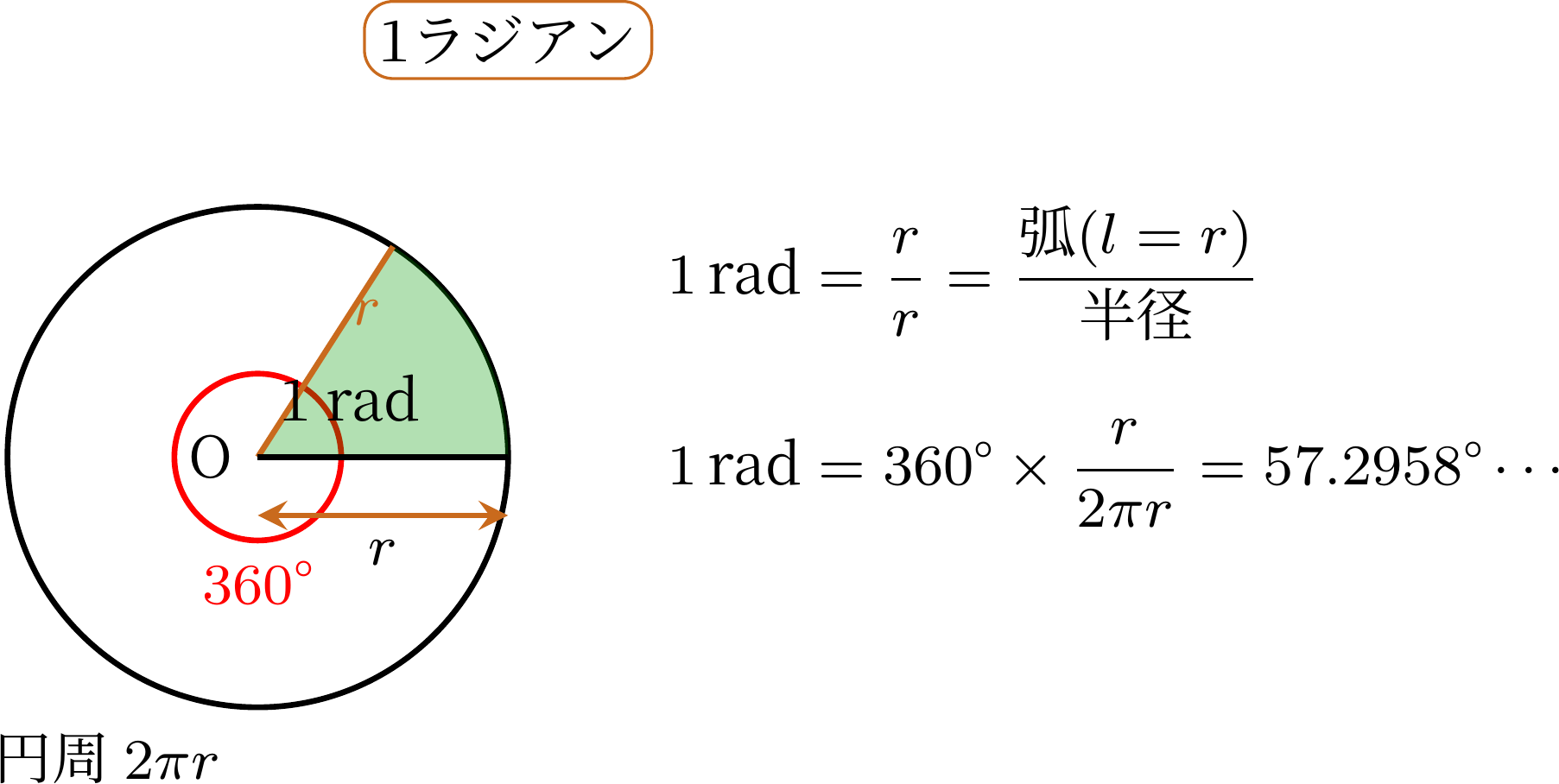
半径1,弧の長さが1の扇形の中心角が1ラジアン。すなわちその相似形である,半径\(r\),弧の長さが\(r\)の扇形の中心角は1ラジアン(以下,rad)。
→ 単位円の円周の長さは\(2\pi\)であるから,その中心角\(360^{\circ} =\class{mathkuu}{\underline{2\pi}}\)[rad]\(\ \ \therefore 180^{\circ}=\class{mathkuu}{\underline{\pi}}\) [rad]
例題3つ:
→ 単位円の円周の長さは\(2\pi\)であるから,その中心角\(360^{\circ} =\class{mathkuu}{\underline{2\pi}}\)[rad]\(\ \ \therefore 180^{\circ}=\class{mathkuu}{\underline{\pi}}\) [rad]
例題3つ:
- \(60^{\circ}\) は、\(\class{mathkuu}{\underline{\dfrac{\pi}{3}}}\)[rad]
- \(\dfrac{\pi}{3}\)[rad]は、\(\class{mathkuu}{\underline{60^{\circ}}}\)
- \(\dfrac{1}{3}\) [rad]は、\(\class{mathkuu}{\underline{\left(\dfrac{60}{\pi}\right) ^{\circ}}}\) ※特にこのパターンもできるように。
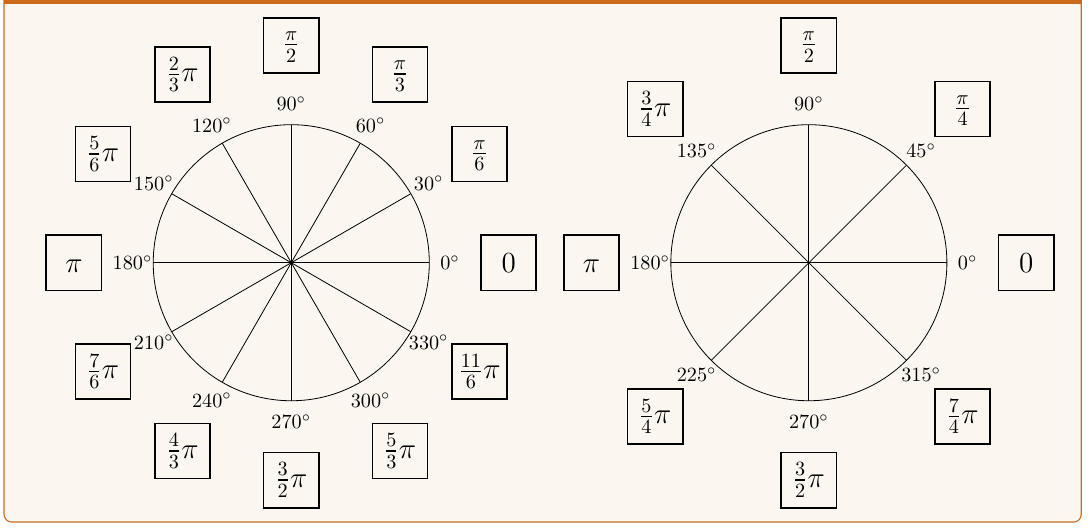
Point 2BC 3.2.3 頻出角のラジアン
Point 2BC 3.2.4
\(角\alpha\) の動径OPの表す一般角\(\theta は\)
\[\theta = \alpha + \class{mathkuu}{\underline{2n\pi}} \quad (nは整数)\]
\[\theta = \alpha + \class{mathkuu}{\underline{2n\pi}} \quad (nは整数)\]
Point 2BC 3.2.5 弧の長さと面積
半径\(r\),中心角\(\theta\)(ラジアン)の扇形について
- 弧の長さ\(l\) \(l=\)\(r\theta\)
- 面積\(S\) \(S=\class{mathkuu}{\underline{\dfrac{1}{2}r^2\theta}} \left( =\class{mathkuu}{\underline{\dfrac{1}{2}rl}}\right)\)
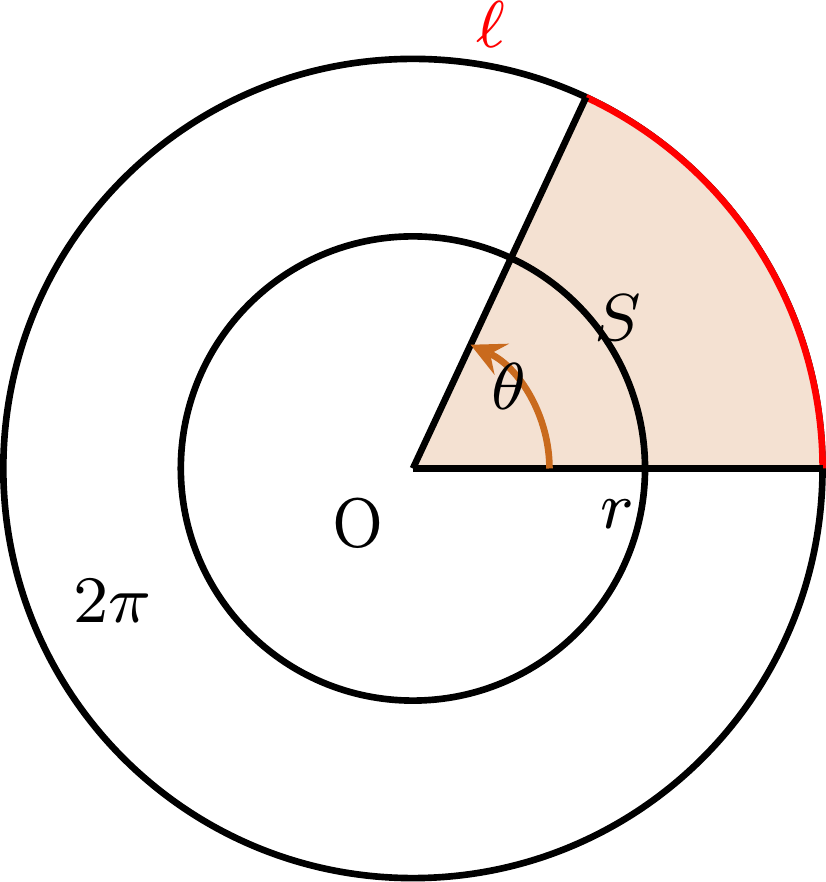
\(\because\) (1)は弧度法の定義から
※(2)は円の面積\(\pi r^2\)の\(\class{mathkuu}{\underline{\dfrac{\theta}{2\pi}}}\)倍(円は中心角\(2\pi\))。すなわち\(\pi r^2\times\dfrac{\theta}{2\pi}=\dfrac{1}{2}r^2\theta\)。または,弧の部分を底辺,半径を高さに見立てて,三角形の面積公式(底辺\(\times\)高さ\(\div2\))のように,\(\dfrac{1}{2}rl\)と認識してもよい。中心角\(\theta\)で求める場合は前者,中心角がわからず弧の長さ\(l\)で求める場合は後者を用いよう。
※(2)は円の面積\(\pi r^2\)の\(\class{mathkuu}{\underline{\dfrac{\theta}{2\pi}}}\)倍(円は中心角\(2\pi\))。すなわち\(\pi r^2\times\dfrac{\theta}{2\pi}=\dfrac{1}{2}r^2\theta\)。または,弧の部分を底辺,半径を高さに見立てて,三角形の面積公式(底辺\(\times\)高さ\(\div2\))のように,\(\dfrac{1}{2}rl\)と認識してもよい。中心角\(\theta\)で求める場合は前者,中心角がわからず弧の長さ\(l\)で求める場合は後者を用いよう。
Point 2BC 3.2.6 三角関数の相互関係
① \(\class{mathkuu}{\underline{\tan\theta=\dfrac{\sin\theta}{\cos\theta}}}\),
② \(\class{mathkuu}{\underline{\sin^2\theta+\cos^2\theta=1}}\),
③ \(\class{mathkuu}{\underline{1+\tan^2\theta=\dfrac{1}{\cos^2\theta}}}\)
※これらの式は、問題文に書かれていなくても常に成り立っている隠れた条件であることに注意※③は②の両辺を\(\cos^2\theta\)で割ったものなのですぐに導けるように
※③の式は,\(\tan^2\theta\)と\(\cos^2\theta\)は交換可能であると日本語で認識しておこう!
※\(\tan \theta\)は、\(\theta=\)\(\dfrac{\pi}{2}+n\pi\)(\(n\)は整数)で定義されない (\(\because \cos \theta=0, \tan\theta=\dfrac{\sin\theta}{\cos\theta}\))
Point 2BC 3.2.7 変換公式まとめ
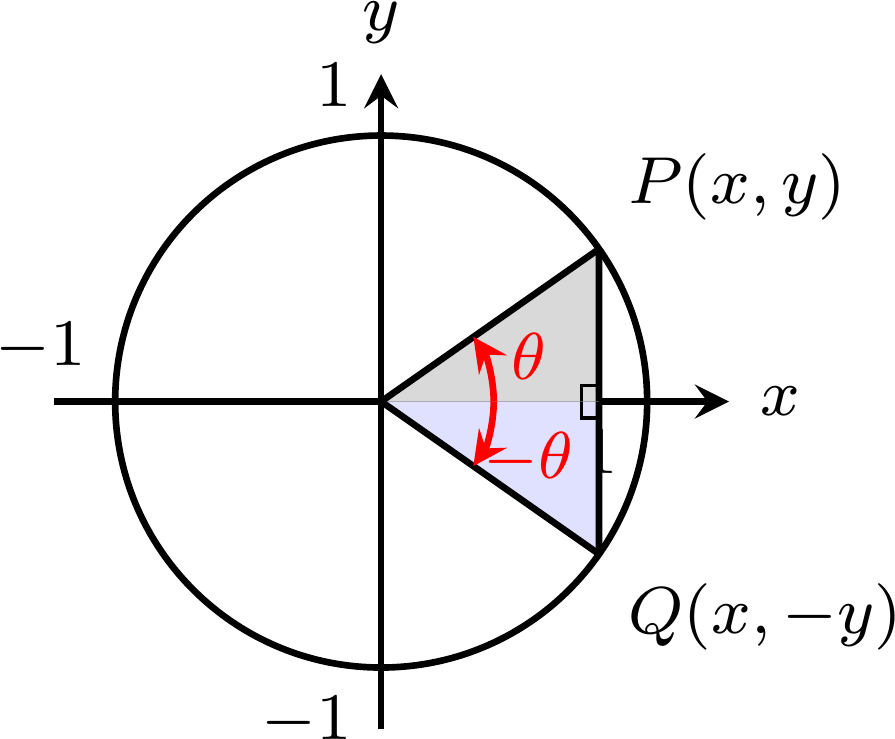
Point 2BC 3.2.8 \(【\ \theta + 2n\pi \: 】,【-\theta \ 】型\)
\(n\)は整数とする。
\[\ \ \sin (\theta + 2n\pi)=\class{mathkuu}{\underline{ \sin\theta}}\]
\[\ \ \cos (\theta + 2n\pi)=\class{mathkuu}{\underline{ \cos\theta }}\]
\[\ \ \tan (\theta + 2n\pi)=\class{mathkuu}{\underline{\tan\theta }} \]
\[\sin (-\theta )=\class{mathkuu}{\underline{ -\sin\theta }}\]
\[\cos (-\theta )=\class{mathkuu}{\underline{ \ \ \cos\theta }}\]
\[\tan (-\theta )=\class{mathkuu}{\underline{-\tan\theta }}\]
Point 2BC 3.2.9 \(【\ \theta + \pi \: 】型\)
\[ \sin (\theta +\pi)=\class{mathkuu}{\underline{ -\sin\theta }} \]
\[\cos (\theta +\pi )=\class{mathkuu}{\underline{ -\cos\theta }}\]
\[\tan (\theta + \pi )=\class{mathkuu}{\underline{ \tan\theta }}\]
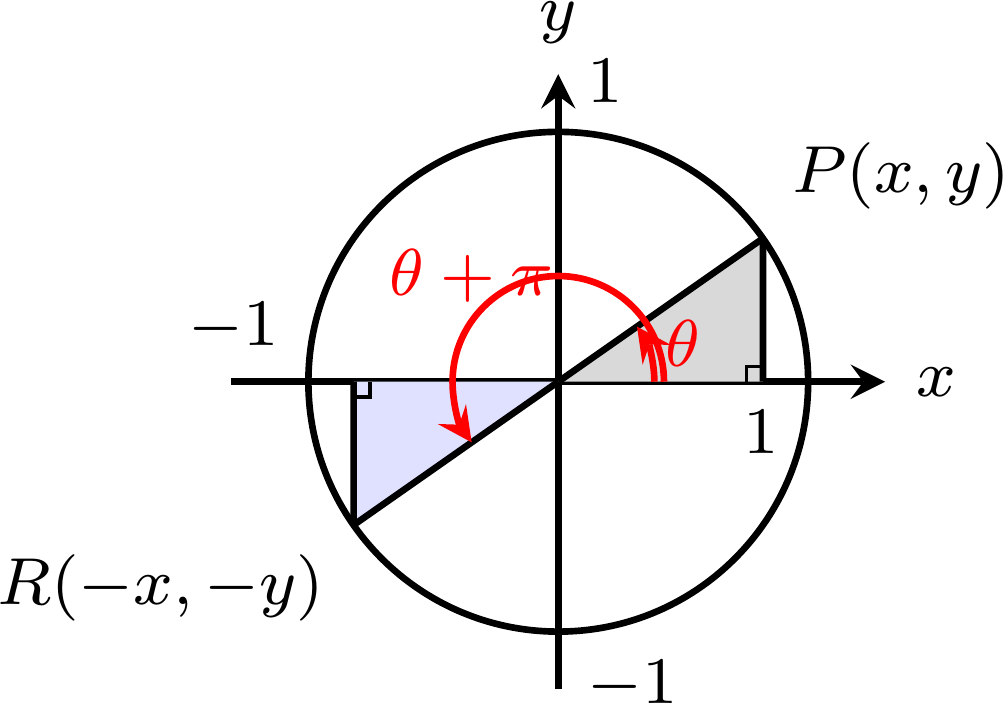
Point 2BC 3.2.10 \(【\ \theta +\frac{\pi}{2}\: 】型\)
\[ \sin \Bigl( \theta +\dfrac{\pi}{2} \Bigr) =\class{mathkuu}{\underline{\cos\theta }}\]
\[\cos \Bigl( \theta +\dfrac{\pi}{2} \Bigr) =\class{mathkuu}{\underline{-\sin\theta }}\]
\[\tan \Bigl( \theta + \dfrac{\pi}{2} \Bigr) =\class{mathkuu}{\underline{-\dfrac{1}{\tan\theta}}} (\because \tan\theta=\dfrac{\sin\theta}{\cos\theta})\]
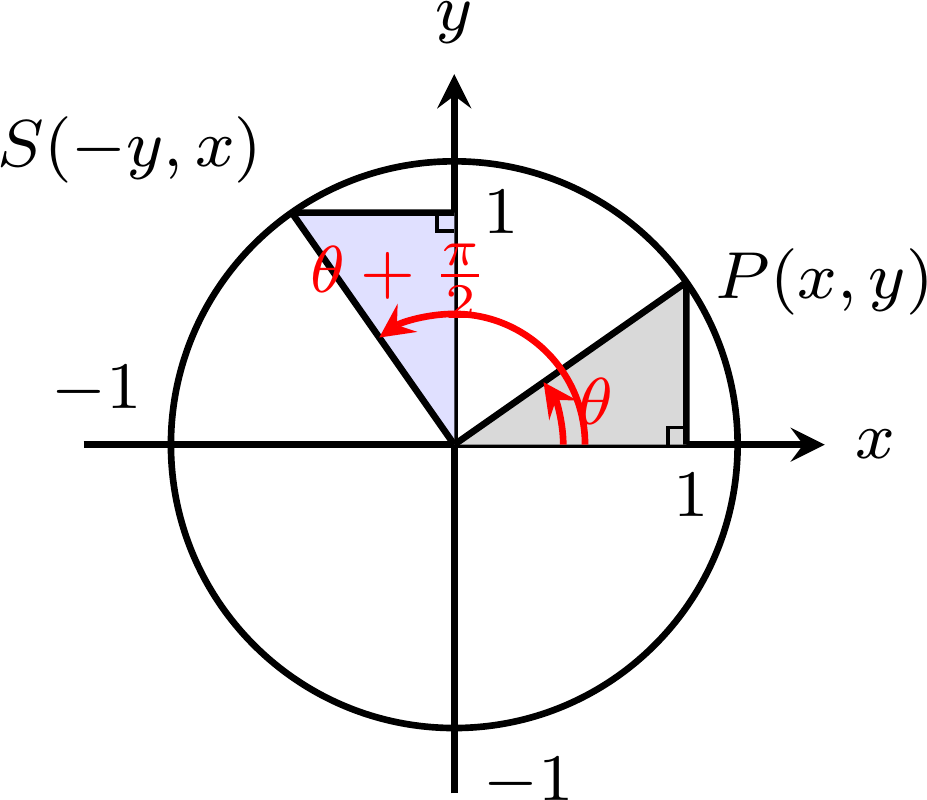
Point 2BC 3.2.11 \(【\ \pi - \theta \:】型\)
\[ \sin (\pi - \theta ) =\class{mathkuu}{\underline{\sin\theta }}\]
\[\cos (\pi - \theta ) =\class{mathkuu}{\underline{-\cos\theta }}\]
\[\tan ( \pi - \theta ) =\class{mathkuu}{\underline{-\tan\theta }}\]
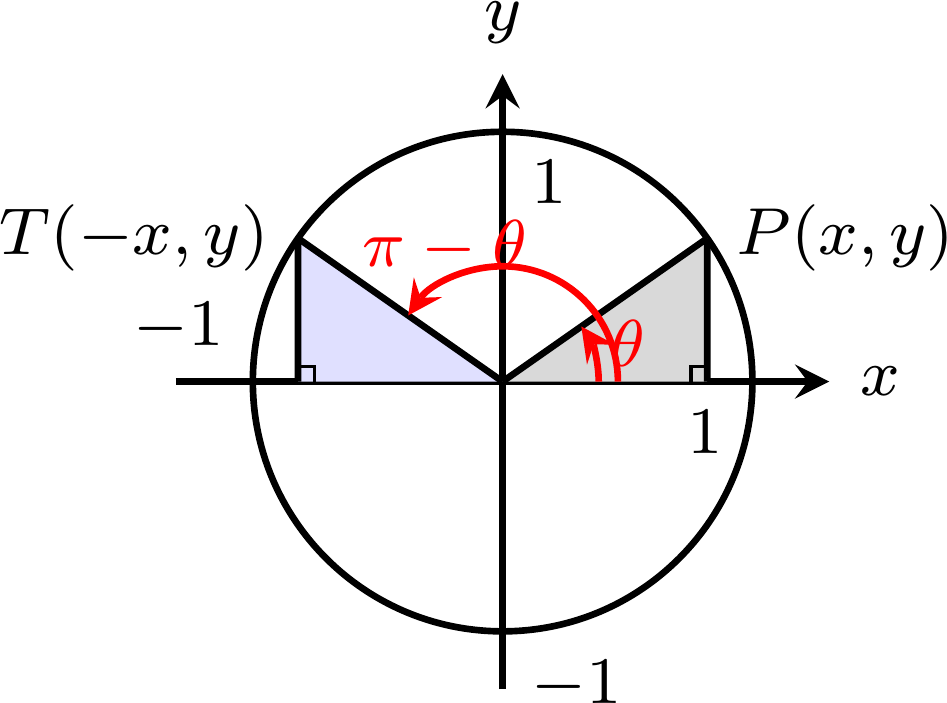
Point 2BC 3.2.12 \(【\ \frac{\pi}{2}- \theta\: 】型\)
\[\sin \Bigl( \dfrac{\pi}{2}- \theta \Bigr) =\class{mathkuu}{\underline{\cos \theta}} \]
\[\cos \Bigl( \dfrac{\pi}{2}- \theta \Bigr) =\class{mathkuu}{\underline{\sin \theta }}\]
\[\tan \Bigl( \dfrac{\pi}{2}- \theta \Bigr) =\class{mathkuu}{\underline{\dfrac{1}{\tan \theta}}}\]
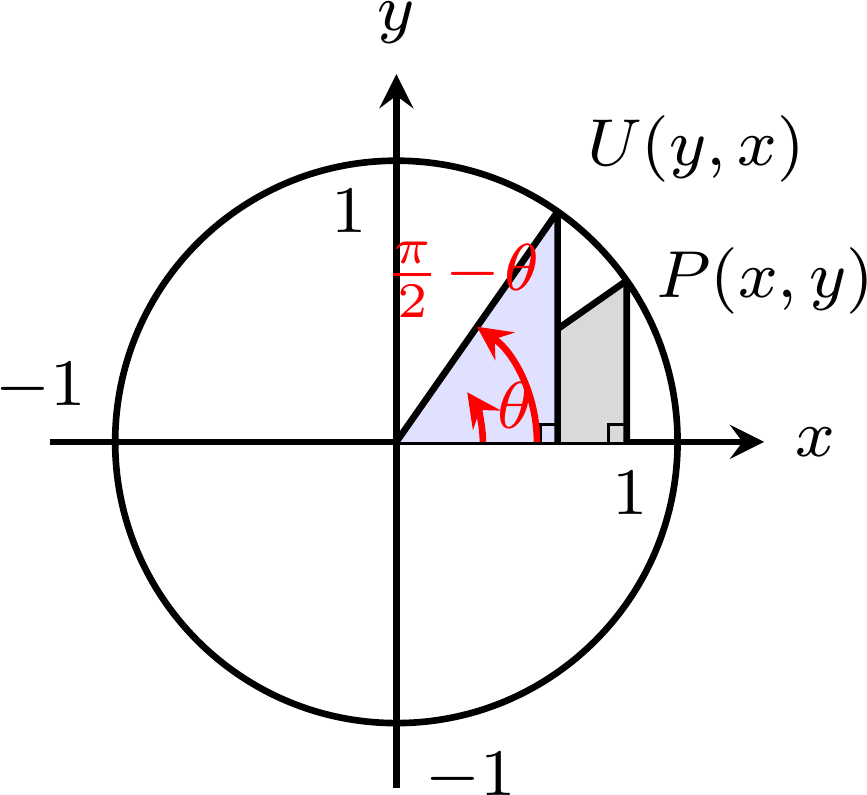
これらの変換公式の本質\(\cdots\)「任意の角の三角関数はすべて第1象限の三角関数でも表せる!」
※ 数Ⅱを習うことで忘れがちだが,\(\dfrac{\pi}{2}- \theta\)系は直角三角形を書けば一瞬。(数Ⅰの定義通り)
※ 最悪\(\tan \dfrac{\pi}{2}\)がでてくるもの以外は加法定理でも良いが,パッと図を描いて判断したい。
※ 数Ⅱを習うことで忘れがちだが,\(\dfrac{\pi}{2}- \theta\)系は直角三角形を書けば一瞬。(数Ⅰの定義通り)
※ 最悪\(\tan \dfrac{\pi}{2}\)がでてくるもの以外は加法定理でも良いが,パッと図を描いて判断したい。
Point 2BC 3.2.13 三角関数のグラフの特徴まとめ
| \( y = \sin\theta \) | \( y = \cos\theta \) | \( y = \tan\theta \) | |
| 値 域 | \(\class{mathkuu}{\underline{ -1 \leqq y \leqq 1 }}\) | \(\class{mathkuu}{\underline{ -1 \leqq y \leqq 1 }}\) | \(\class{mathkuu}{\underline{すべての実数値}}\) |
| 周 期 | \( \class{mathkuu}{\underline{2\pi}} \) | \( \class{mathkuu}{\underline{2\pi}} \) | \( \class{mathkuu}{\underline{\pi}} \) |
| グラフの対称性 | 原点対称 | \( y \) 軸対称 | 原点対称 |
\(y=\tan \theta\)のグラフは,次の直線を漸近線にもつ。\(n\)を整数として, \[直線\ \theta=\class{mathkuu}{\underline{\dfrac{\pi}{2}+n\pi}}\]
Point 2BC 3.2.14 グラフの平行・対称移動【復習】と対称性のまとめ
以下の関数のグラフは,関数\(y=f(x)\)のグラフを,
また,関数\(y=f(x)\)が以下の条件を満たすとき,グラフは次の対称性をもつ。
したがって、 \(y=\sin \theta ,\ \ y=\tan \theta\)は奇関数、\(y=\cos \theta \)は偶関数 である。
(※\(x\)軸対称は,陰関数表示で\(f(x,-y)=f(x,y)\)とすれば表せるが今はわかりやすさ重視で割愛)
- \(y-q=f(x-p)\):\(x軸方向に\class{mathkuu}{\underline{p}},y軸方向に\class{mathkuu}{\underline{q}}だけ\class{mathkuu}{\underline{平行}}移動\)
- \(-y=f(x)\: (y=-f(x))\): \(x\)軸に関して対称移動
- \(y=f(-x):\ \)\(y\)軸に関して対称移動
- \((y=-f(-x)):\ \)原点に関して対称移動
また,関数\(y=f(x)\)が以下の条件を満たすとき,グラフは次の対称性をもつ。
i) \(f(-x)=f(x)\): \(y\)軸に関して対称 (偶関数)
ii) \(-f(-x)=f(x):\ \)原点に関して対称 (奇関数)
したがって、 \(y=\sin \theta ,\ \ y=\tan \theta\)は奇関数、\(y=\cos \theta \)は偶関数 である。
(※\(x\)軸対称は,陰関数表示で\(f(x,-y)=f(x,y)\)とすれば表せるが今はわかりやすさ重視で割愛)
Point 2BC 3.2.15 三角関数の周期
\(y=\sin \theta ,\ \ y=\cos \theta\)は、\(2\pi\)を周期とする周期関数であり、
\(y=\tan \theta\)は、\(\pi\)を周期とする周期関数である。
※周期と言えば、正の周期のうち最小のものを意味するのが通例。
\(y=\tan \theta\)は、\(\pi\)を周期とする周期関数である。
Point 2BC 3.2.16 \(k\theta\)なら周期は・・・?
一般に、\(k\)が正の定数のとき、次のことが成り立つ。
関数\(y=\sin k\theta,\ \ y=\cos k\theta\)の周期はともに\(\dfrac{2\pi}{k}\)であり、
関数\(y=\tan k\theta\)の周期は\(\dfrac{\pi}{k}\)である。
※\(\theta\)に入れた値が\(k\)倍されてしまうので、\(\dfrac{1}{k}\)倍の値を入れると同じ値がでる、と考える。
(もしくは\(k\theta\)をひとまりと考えると、\(k\theta=2\pi\))
※例えば\(k=\dfrac{1}{2}\)のように小数のときは\(\dfrac{1}{k}=2\)となることにも注意
関数\(y=\sin k\theta,\ \ y=\cos k\theta\)の周期はともに\(\dfrac{2\pi}{k}\)であり、
関数\(y=\tan k\theta\)の周期は\(\dfrac{\pi}{k}\)である。
※\(\theta\)に入れた値が\(k\)倍されてしまうので、\(\dfrac{1}{k}\)倍の値を入れると同じ値がでる、と考える。
(もしくは\(k\theta\)をひとまりと考えると、\(k\theta=2\pi\))
※例えば\(k=\dfrac{1}{2}\)のように小数のときは\(\dfrac{1}{k}=2\)となることにも注意
Point 2BC 3.2.17 三角関数の平行・拡大縮小まとめ
- \[y=●\sin\theta \hspace{28mm}:\class{mathkuu}{\underline{y}}軸方向に\class{mathkuu}{\underline{●倍}}(\class{mathkuu}{\underline{振幅}}|●|倍)\]
- \[y=\sin(\theta+●) \hspace{22mm}:\class{mathkuu}{\underline{\theta}}軸方向に\class{mathkuu}{\underline{-●}}だけ平行移動(\boldsymbol{位相がずれる})\]
- \[y=\sin ●\theta \hspace{28.4mm}:\class{mathkuu}{\underline{\theta}} 軸方向に\class{mathkuu}{\underline{\dfrac{1}{●}倍}}(\class{mathkuu}{\underline{周期}}\dfrac{1}{|●|}倍)\]
- \[y=\sin \theta +●\hspace{22mm}:\class{mathkuu}{\underline{y}}軸方向に\class{mathkuu}{\underline{●}}だけ平行移動\]
- 複合形\(y=●\sin(▲\theta+○)+△\) :このパターン要注意。必ずまず\(\sin ▲\left( \theta +\dfrac{○}{▲}\right)\)と変形
例)\(y=2\sin\left(3\theta-\dfrac{\pi}{3}\right)+1\)は,
\[y=2\sin 3\left(\theta-\dfrac{\pi}{9}\right)+1\]
と変形できるので,\(y=\sin 3\theta\)のグラフを\(\theta\)軸方向に\(\dfrac{\pi}{9}\)だけ平行移動し,\(y\)軸方向に\(2\)倍に拡大し,さらに\(y\)軸方向に\(1\)だけ平行移動したもの,とわかる。
Point 2BC 3.2.18 【発展】周期関数
\[関数f(x)について,xがc増えるごとに周期性がある:すべてのxで\ \underline{f(x+c)=f(x)}\ が成り立つ。\]
方程式・不等式,最大・最小
Point 2BC 3.3.1 方程式・不等式,最大・最小問題の解き方
- STEP 1:\(\theta\)の範囲check!!
- STEP 2:位相部分の範囲check!!
- STEP 3:\(\sin\) ,\(\cos\) ,\(\tan\) \( \gtreqqless \) などの形に変形し,単位円描いて求める!
\(\star\) \(\sin\theta\):単位円の\(y\) 座標,\(\cos\theta\):単位円の\(x\) 座標,\(\tan\theta\):単位円と\(x = 1\) との交点,に現れる!
Point 2BC 3.3.2 三角関数の式処理の定石
三角関数ときたら・・・
→ 角と種類を統一せよ!
Point 2BC 3.3.3
\[\class{mathkuu}{\underline{似た形}}はおきかえる,文字おきかえたら\class{mathkuu}{\underline{範囲check!!}}\]
→「\(\sin\theta =t\)とすると,\(\sin^2\theta + \sin\theta +1=t^2+t+1\)」のように,三角関数の問題では,角と種類をそろえたあと,似た形をおきかえることで特に2次関数などに帰着させるのが鉄板!ただしその際,\(\theta\)の範囲に気をつけて,置き換えた文字\(t\)の範囲チェックが必要!
このようにすることで,「範囲あり2次関数の方程式・不等式,最大最小問題」などへとテーマが変わり,あとは数Ⅰで習った通り,平方完成→グラフ→\(t\)の範囲に気をつけて・・・と解いていこう!
このようにすることで,「範囲あり2次関数の方程式・不等式,最大最小問題」などへとテーマが変わり,あとは数Ⅰで習った通り,平方完成→グラフ→\(t\)の範囲に気をつけて・・・と解いていこう!
加法定理と,加法定理から導かれる公式
Point 2BC 3.4.1 加法定理
\[
\begin{aligned}
\sin(\alpha\pm\beta)&=\class{mathkuu}{\underline{\sin\alpha\cos\beta\pm\cos\alpha\sin\beta}},\\
%\sin(\alpha-\beta)=\sin\alpha\cos\beta-\cos\alpha\sin\beta\\
\cos(\alpha\pm\beta)&=\class{mathkuu}{\underline{\cos\alpha\cos\beta\mp\sin\alpha\sin\beta}},\\
%\cos(\alpha-\beta)=\cos\alpha\cos\beta+\sin\alpha\sin\beta\\
\tan(\alpha\pm\beta)&=\class{mathkuu}{\underline{\dfrac{\tan\alpha\pm\tan\beta}{1\mp\tan\alpha\tan\beta}}}
%\tan(\alpha-\beta)=\dfrac{\tan\alpha-\tan\beta}{1+\tan\alpha\tan\beta}
\end{aligned}
\]
※\(\tan\)の分母は\(\cos\)由来だからプラマイ入れ替わる
Point 2BC 3.4.2 2倍角の公式
\[
\begin{aligned}
\sin2\alpha&=\class{mathkuu}{\underline{2\sin\alpha\cos\alpha}}\\
%\begin{align*}
\cos2\alpha&=\class{mathkuu}{\underline{\cos^{2}\alpha-\sin^{2}\alpha}} \quad &・・・①\\
&=\class{mathkuu}{\underline{2\cos^{2}\alpha-1}} &・・・②\\
&=\class{mathkuu}{\underline{1-2\sin^{2}\alpha}} &・・・③\\
%\begin{align*}
\tan2\alpha&=\class{mathkuu}{\underline{\frac{2\tan\alpha}{1-\tan^{2}\alpha}}}
\end{aligned}
\]
Point 2BC 3.4.3
「2倍の角度を」半分にできる式。
※cosの2倍角は一つ目を覚えて残りは導出。\(\tan\)は加法定理からか\(\tan2\alpha=\dfrac{\sin2\alpha}{\cos2\alpha}\)から導出すればよい。
※2倍角の公式は,忘れたら加法定理で\(\alpha =\beta\)として簡単に導出できる
※cosの2倍角は一つ目を覚えて残りは導出。\(\tan\)は加法定理からか\(\tan2\alpha=\dfrac{\sin2\alpha}{\cos2\alpha}\)から導出すればよい。
※2倍角の公式は,忘れたら加法定理で\(\alpha =\beta\)として簡単に導出できる
Point 2BC 3.4.4 半角の公式
\[
\begin{aligned}
\sin^{2}\dfrac{\alpha}{2}&=\class{mathkuu}{\underline{\dfrac{1-\cos\alpha}{2}}}\\
%\begin{align*}
\cos^{2}\dfrac{\alpha}{2}&=\class{mathkuu}{\underline{\dfrac{1+\cos\alpha}{2}}}\\
\tan^{2}\dfrac{\alpha}{2}&=\class{mathkuu}{\underline{\dfrac{1-\cos\alpha}{1+\cos\alpha}}}
\end{aligned}
\]
※\(\tan\)は\(\tan^{2}\dfrac{\alpha}{2}=\class{mathkuu}{\underline{\dfrac{\sin^{2}\dfrac{\alpha}{2}}{\cos^{2}\dfrac{\alpha}{2}}}}\)から導出すればよい
Point 2BC 3.4.5 半角の公式のメリット
「半分の角度を」2倍にできる式。
最大のメリットは、「2乗を解消できること」(角度が2倍になることが代償)
半角の公式はcosの2倍角の②と③のことなので覚えなくてもよい。
最大のメリットは、「2乗を解消できること」(角度が2倍になることが代償)
半角の公式はcosの2倍角の②と③のことなので覚えなくてもよい。
Point 2BC 3.4.6 \(\sin,\cos\)の2次同次式は,半角で次数下げ
半角の公式のメリットは、角度が2倍になることを代償に「2乗を解消できること」
例:\(f(x)=2\sin ^{2} x+2 \sin x \cos x+4\cos ^{2} x\)の最大値・最小値
→ \[f(x)=2\cdot \dfrac{1-\cos 2x}{2}+\sin 2x+4\cdot \dfrac{1+\cos 2x}{2}\] \[=\sin 2x+\cos 2x+3\] \[=\sqrt{2}\sin \left(2x+\dfrac{\pi}{4} \right)+3\]
となり、2乗が解消されたとともに角度が\(2x\)で揃う!あとは単位円でチェック
例:\(f(x)=2\sin ^{2} x+2 \sin x \cos x+4\cos ^{2} x\)の最大値・最小値
→ \[f(x)=2\cdot \dfrac{1-\cos 2x}{2}+\sin 2x+4\cdot \dfrac{1+\cos 2x}{2}\] \[=\sin 2x+\cos 2x+3\] \[=\sqrt{2}\sin \left(2x+\dfrac{\pi}{4} \right)+3\]
となり、2乗が解消されたとともに角度が\(2x\)で揃う!あとは単位円でチェック
Point 2BC 3.4.7 3倍角の公式
\(\sin3\alpha=\)\(3\sin\alpha-4\sin^{3}\alpha\)
\(\cos3\alpha=\)\(4\cos^{3}\alpha-3\cos\alpha\)
\(\cos3\alpha=\)\(4\cos^{3}\alpha-3\cos\alpha\)
Point 2BC 3.4.8
覚え方:「サンシャイン、引いて夜風が身に染みる」
「ヨーコさんの婆さんこすい」(「三振とって4三振」)
忘れたら\(3\alpha=\class{mathkuu}{\underline{2\alpha+\alpha}}\)として加法定理から導出
「ヨーコさんの婆さんこすい」(「三振とって4三振」)
忘れたら\(3\alpha=\class{mathkuu}{\underline{2\alpha+\alpha}}\)として加法定理から導出
Point 2BC 3.4.9 和積・積和の公式
和積
・\(\class{mathkuu}{\underline{\sin{A}+\sin{B}=2 \sin\dfrac{A+B}{2}\cos\dfrac{A-B}{2}}}\)
・\(\class{mathkuu}{\underline{\sin{A}-\sin{B}=2 \cos\dfrac{A+B}{2}\sin\dfrac{A-B}{2}}}\)
・\(\class{mathkuu}{\underline{\cos{A}+\cos{B}=2 \cos\dfrac{A+B}{2}\cos\dfrac{A-B}{2}}}\)
・\(\class{mathkuu}{\underline{\cos{A}-\cos{B}=-2 \sin\dfrac{A+B}{2}\sin\dfrac{A-B}{2}}}\)
積和(和積で\(\class{mathkuu}{\underline{\dfrac{A+B}{2}}}=\alpha、\class{mathkuu}{\underline{\dfrac{A-B}{2}}}=\beta\)とおくと導ける)
・\(\class{mathkuu}{\underline{\sin\alpha\cos\beta=\dfrac{1}{2}\{ \sin(\alpha+\beta)+\sin(\alpha-\beta)\}}}\)
・\(\class{mathkuu}{\underline{\cos\alpha\sin\beta=\dfrac{1}{2}\{ \sin(\alpha+\beta)-\sin(\alpha-\beta)\}}}\)
・\(\class{mathkuu}{\underline{\cos\alpha\cos\beta=\dfrac{1}{2}\{ \cos(\alpha+\beta)+\cos(\alpha-\beta)\}}}\)
・\(\class{mathkuu}{\underline{\sin\alpha\sin\beta=-\dfrac{1}{2}\{ \cos(\alpha+\beta)-\cos(\alpha-\beta)\}}}\)
・\(\class{mathkuu}{\underline{\sin{A}+\sin{B}=2 \sin\dfrac{A+B}{2}\cos\dfrac{A-B}{2}}}\)
・\(\class{mathkuu}{\underline{\sin{A}-\sin{B}=2 \cos\dfrac{A+B}{2}\sin\dfrac{A-B}{2}}}\)
・\(\class{mathkuu}{\underline{\cos{A}+\cos{B}=2 \cos\dfrac{A+B}{2}\cos\dfrac{A-B}{2}}}\)
・\(\class{mathkuu}{\underline{\cos{A}-\cos{B}=-2 \sin\dfrac{A+B}{2}\sin\dfrac{A-B}{2}}}\)
積和(和積で\(\class{mathkuu}{\underline{\dfrac{A+B}{2}}}=\alpha、\class{mathkuu}{\underline{\dfrac{A-B}{2}}}=\beta\)とおくと導ける)
・\(\class{mathkuu}{\underline{\sin\alpha\cos\beta=\dfrac{1}{2}\{ \sin(\alpha+\beta)+\sin(\alpha-\beta)\}}}\)
・\(\class{mathkuu}{\underline{\cos\alpha\sin\beta=\dfrac{1}{2}\{ \sin(\alpha+\beta)-\sin(\alpha-\beta)\}}}\)
・\(\class{mathkuu}{\underline{\cos\alpha\cos\beta=\dfrac{1}{2}\{ \cos(\alpha+\beta)+\cos(\alpha-\beta)\}}}\)
・\(\class{mathkuu}{\underline{\sin\alpha\sin\beta=-\dfrac{1}{2}\{ \cos(\alpha+\beta)-\cos(\alpha-\beta)\}}}\)
覚えていなくても、いつでも積和は「加法定理の辺々\(+,-\)から導ける」ように。
また,積和の式から逆に和積の式を求めたいときは,\(\alpha+\beta=A\),\(\alpha-\beta=B\)とおけばよい。
また,積和の式から逆に和積の式を求めたいときは,\(\alpha+\beta=A\),\(\alpha-\beta=B\)とおけばよい。
Point 2BC 3.4.10 三角関数の合成
\(a\sin\theta+b\cos\theta=\class{mathkuu}{\underline{\sqrt{a^2+b^2}\sin(\theta+\alpha)}}\)
ただし、
\[\sin\alpha=\class{mathkuu}{\underline{\dfrac{b}{\sqrt{a^2+b^2}}}},\cos\alpha=\class{mathkuu}{\underline{\dfrac{a}{\sqrt{a^2+b^2}}}}\]
使えるのは,\(\sin,\cos\)の1次式で,かつ\(a\sin□+b\cos□\)の□が同じとき!
また,\(\alpha\)は普通\(-\pi<\alpha≦\pi\) or \(0≦\alpha<2\pi\)の範囲にとる。必要な際は適宜定義を。
※意外と忘れている人が多いが,合成は加法定理と逆の操作である。
また,\(\alpha\)は普通\(-\pi<\alpha≦\pi\) or \(0≦\alpha<2\pi\)の範囲にとる。必要な際は適宜定義を。
※意外と忘れている人が多いが,合成は加法定理と逆の操作である。
その他重要ポイント
Point 2BC 3.5.1 三角関数の各象限ごとの正負
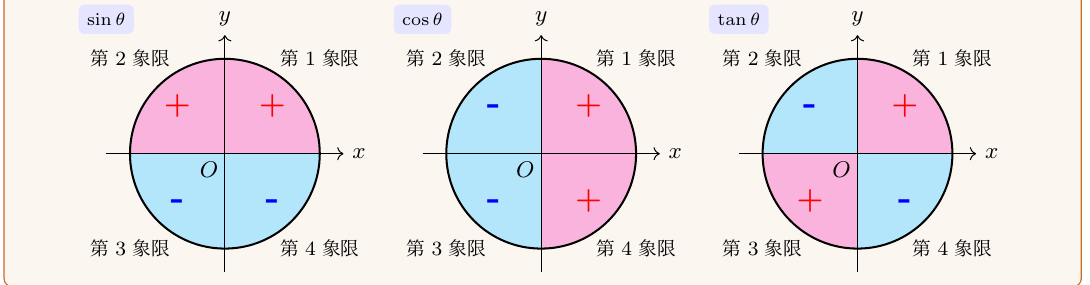
Point 2BC 3.5.2 対称式
\(x,y\)の式で、\(x\)と\(y\)を入れかえても同じ式になるものを対称式という。対称式ときたら・・・
ex.) \[x^2+y^2=(x+y)^2-2xy,\quad x^3+y^3=(x+y)(x^2-xy+y^2)\ \mathrm{or}\ =(x+y)^3-3xy(x+y)\]
※3変数\(x, y, z\)の場合は、基本対称式\(x+y+z, xy+yz+zx, xyz\)で表す!
※対称式は,すべて基本対称式で表せることが知られている。
基本対称式\(x+y, xy\)で表せ!
ex.) \[x^2+y^2=(x+y)^2-2xy,\quad x^3+y^3=(x+y)(x^2-xy+y^2)\ \mathrm{or}\ =(x+y)^3-3xy(x+y)\]
※3変数\(x, y, z\)の場合は、基本対称式\(x+y+z, xy+yz+zx, xyz\)で表す!
※対称式は,すべて基本対称式で表せることが知られている。
Point 2BC 3.5.3 三角関数の対称式
三角関数の場合、\(\sin\theta+\cos\theta,\: \sin\theta\cos\theta\)で表す!
また、\(\sin^2\theta+\cos^2\theta=1\)がかくれた条件として常に成立していることも意識!
また、\(\sin^2\theta+\cos^2\theta=1\)がかくれた条件として常に成立していることも意識!
Point 2BC 3.5.4 三角関数の交代式
\(\sin\theta-\cos\theta\)は、対称式ではなく交代式と呼ばれるが、2乗すると\(\sin^2\theta-2\sin\theta\cos\theta+\cos^2\theta\)となり、対称式に!
Point 2BC 3.5.5 \(\tan\)の加法定理と2直線のなす角
\(\alpha > \beta\)のとき,右の図のような2直線 \(y = m_1 x + n_1\),
\(y = m_2 x + n_2\) のなす角 \(\theta\) は、2直線 \(y = m_1 x\),
\(y = m_2 x\) のなす角 \(\class{mathkuu}{\underline{\alpha - \beta}}\) に等しく、\(\tan \alpha = \class{mathkuu}{\underline{m_1}}\),
\(\tan \beta = \class{mathkuu}{\underline{m_2}}\) であるから、\(m_1 m_2 \mathrel{\bcancel{\mkern-8mu=\mkern-8mu}} -1\) のとき、
\[
\tan \theta =\tan (\class{mathkuu}{\underline{\alpha - \beta}})= \class{mathkuu}{\underline{\dfrac{m_1 - m_2}{1 + m_1 m_2}}}
\]
と表すことができる。
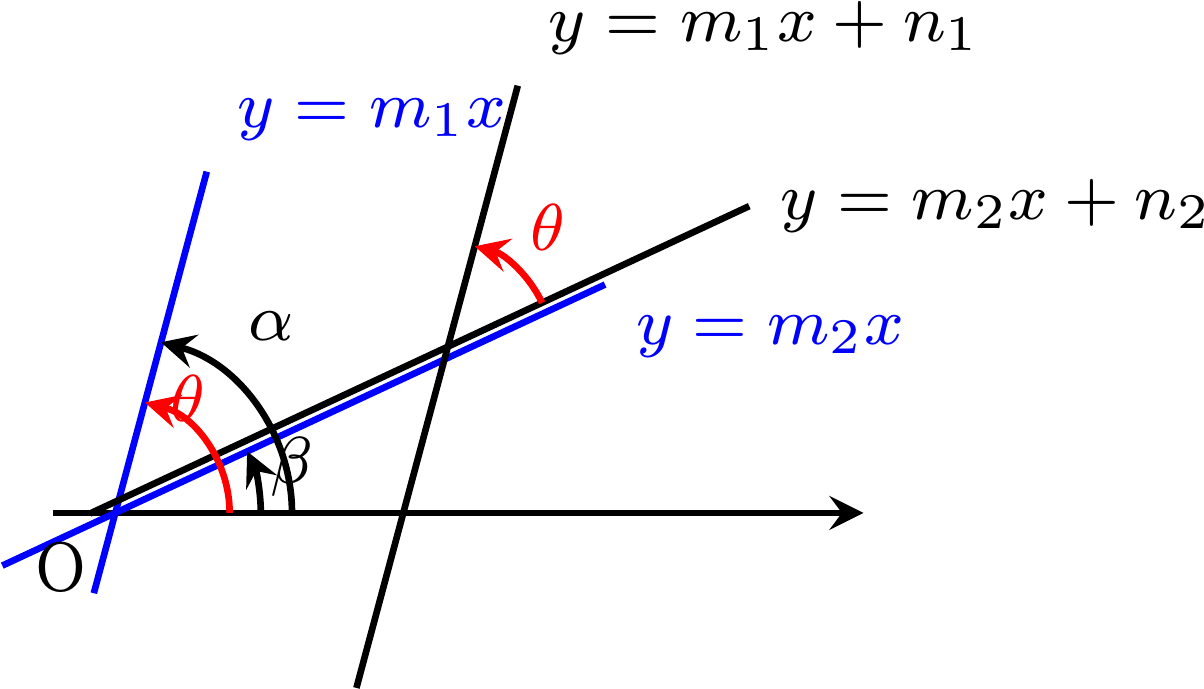
2直線のなす角 \(\theta\) は \(0 \leqq \theta \leqq \dfrac{\pi}{2}\) の範囲で考えることが多く、この計算で\(\tan \theta < 0\)、すなわち、\(\dfrac{\pi}{2} < \theta \leqq \pi\) となる場合は、\(\class{mathkuu}{\underline{\pi - \theta}}\) を2直線のなす角とすればよい。
(ex. \(\tan \theta\) の計算結果が\(-\sqrt{3}\)なら,\(150^{\circ}\) ではなく\(30^{\circ}\) とする,など。)
\(\alpha\)と\(\beta\)の大小関係がわからないときや,その差が鋭角なのか鈍角なのかわからないとき,すなわち,なす鋭角\(\theta\)が,次のすべての場合に対応できる式は,次の式である。
\[\theta =\alpha -\beta,\ \beta -\alpha,\ \pi - (\alpha -\beta),\ \pi - (\beta -\alpha)\]
(\(\because\)いずれの場合も\(\tan \theta =|\tan (\alpha - \beta)|\))
\[\tan \theta =|\tan (\alpha - \beta)|= \class{mathkuu}{\underline{\left|\dfrac{m_1 - m_2}{1 + m_1 m_2}\right|}}\]
Point 2BC 3.5.6 \(\sin\)や\(\cos\),\(\tan\)を怖がらない
\(\sin\)や\(\cos\)が式の中に入っていると難しく見えるが、恐れる必要はない。\(\sin\theta,\ \cos\theta\)は、「2乗の和が1になる、-1以上1以下のただの2つの実数」だと思えばよい。\(\tan\theta\)も同様に、ただのなんらかの実数だと考えればよい。
ただ、その実数値1つに対して\(\theta\)の値が無数に対応しているという点だけが、通常の文字と違うところ。
ただ、その実数値1つに対して\(\theta\)の値が無数に対応しているという点だけが、通常の文字と違うところ。